Bitter Roots by Ellen Crosby
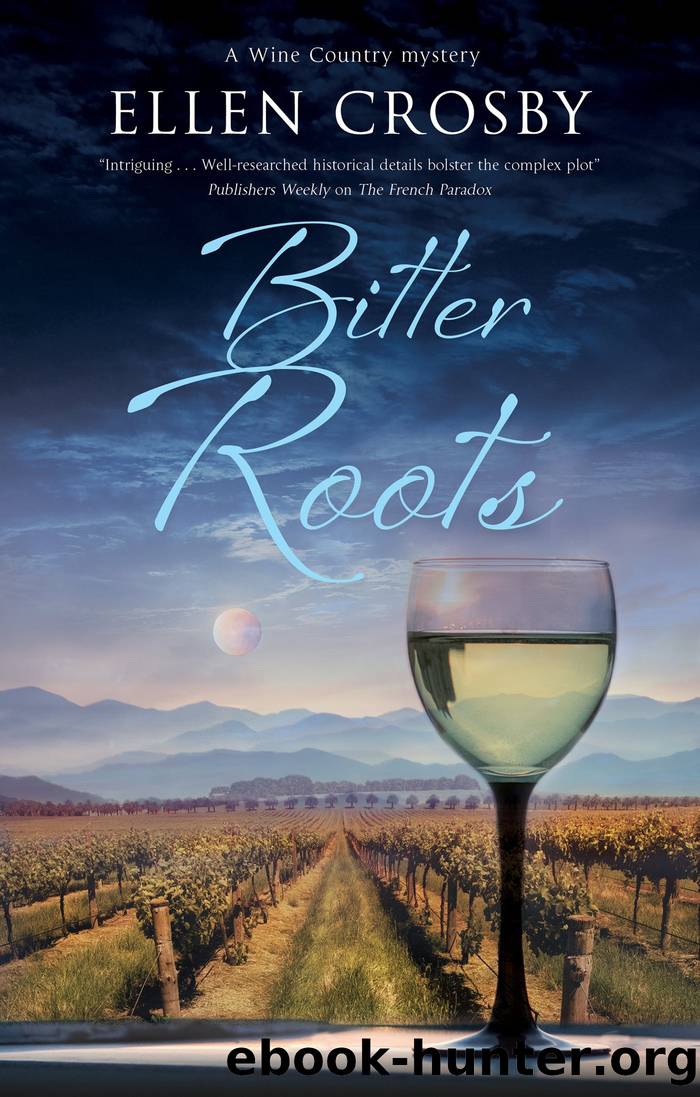
Author:Ellen Crosby [Crosby, Ellen]
Language: eng
Format: epub
Publisher: Severn House
Published: 2021-12-08T00:00:00+00:00
TWELVE
As promised, my grandfather was waiting for us on the veranda, sitting in the wicker loveseat reading Le Monde on his iPad, his glasses perched low on his nose, and a bottle of wine chilling in a silver bucket next to him. Four pale-blue Biot glasses were placed next to the bucket.
Pépé started to get up when he saw David, but David was quicker and got to his side first. âDonât get up, Luc, please. Itâs good to see you again.â
They exchanged kisses on the cheek â David was getting used to our French ways by now â and then he joined me on the glider across from my grandfather.
He unzipped a satchel heâd brought from his car and pulled out a slim, soft-covered book that he handed to me. His book on the Confederate monuments. The cover was simple and stark. White words on an all-black background: The Monuments of the Lost Cause.
The Lost Cause of the Confederacy. It was the southern explanation of what the Civil War had really been about: the issue of statesâ rights. Not about slavery. That the states could make their own decisions about contentious issues â such as slavery, for example â and not be bossed around by the federal government. Truth be told, it was a rather romanticized reimagining long after the war was over: although the South had lost, its cause had been noble and just, a valiant battle against Northern Aggression to preserve the chivalric values of the Antebellum South.
As for the monuments, most of them had been erected in the late 1890s and early 1900s, decades after the last battle had been fought, during a period marked by racial segregation that was known as the Jim Crow era. The statues were not so much about memorializing Confederate war heroes, but a reminder that the Lost Cause lived on. That it hadnât been forgotten. Virginia, the capital of the Confederacy, had erected more statues than any other state â hundreds of them â as well as naming roads, schools, and public places for Lee, Stonewall, Stuart, and the others. The northern states took a different view of what the war had been about â that it most definitely was about slavery.
The photographs in Davidâs book took my breath away, they were so intense and angry. Close-ups of the graffiti, a lot of profanity, covering the statues of Southern generals and war heroes, most of whom had graced Monument Avenue in Richmond for over a century, now paint-splattered in gaudy cartoonish colors. David had taken multiple pictures of the same monuments over time, so it was possible to see the evolution of the first words, epithets, and images which then disappeared underneath layer upon layer of paint and more graffiti until the final result looked like an angry explosion of color. The red paint looked â as it was meant to â like blood.
Pépé silently uncorked the wine and filled three glasses. âAre those your photographs, David?â he asked.
âThey are.â
I passed him the book and my grandfather handed each of us a glass of wine.
Download
This site does not store any files on its server. We only index and link to content provided by other sites. Please contact the content providers to delete copyright contents if any and email us, we'll remove relevant links or contents immediately.
The Secret History by Donna Tartt(19480)
Shot Through the Hearth by Kate Carlisle(18894)
Who'd Have Thought by G Benson(16734)
The Betrayed by David Hosp(13000)
Red by Erica Spindler(12720)
Kathy Andrews Collection by Kathy Andrews(12109)
Scorched Eggs by Childs Laura(11449)
Thirteen Reasons Why by Jay Asher(9135)
Heavenfield: A DCI Ryan Mystery (The DCI Ryan Mysteries Book 3) by LJ Ross(8197)
(2T) A Bone to Pick by Harris Charlaine(7874)
Two Kinds of Truth by Michael Connelly(7533)
Small Great Things by Jodi Picoult(7333)
The Thirst by Nesbo Jo(7114)
The Space Between by Michelle L. Teichman(7044)
Pandemic (The Extinction Files Book 1) by A.G. Riddle(6694)
The Rosie Project by Graeme Simsion(6621)
The Vegetarian by Han Kang(6426)
Assassin’s Fate by Robin Hobb(6386)
Vow of Obedience by Veronica Black(6281)
